A Simple Model of Co-Emergence of Grid and Place Fields

arXiv preprint, 2026
Zhaoze Wang1
zhaoze@seas.upenn.edu
Genela Morris2,3
genelam@tlvmc.gov.il
Dori Derdikman4
derdik@technion.ac.il
Pratik Chaudhari1
pratikac@seas.upenn.edu
Vijay Balasubramanian5,6
vijay@physics.upenn.edu
1 Dept. of Electrical and Systems Engineering, University of Pennsylvania
2 Tel Aviv Sourasky Medical Center   3 Gray Faculty of Medical and Health Sciences, Tel Aviv University
4 Rappaport Faculty of Medicine, Technion - Israel Institute of Technology
5 Dept. of Physics, University of Pennsylvania   6 Santa Fe Institute

TL;DR

A recurrent network trained on a single task, predicting the next sensory observation, develops both grid-like and place-like spatial representations. Neither code is supplied as a target or assumed to exist beforehand.

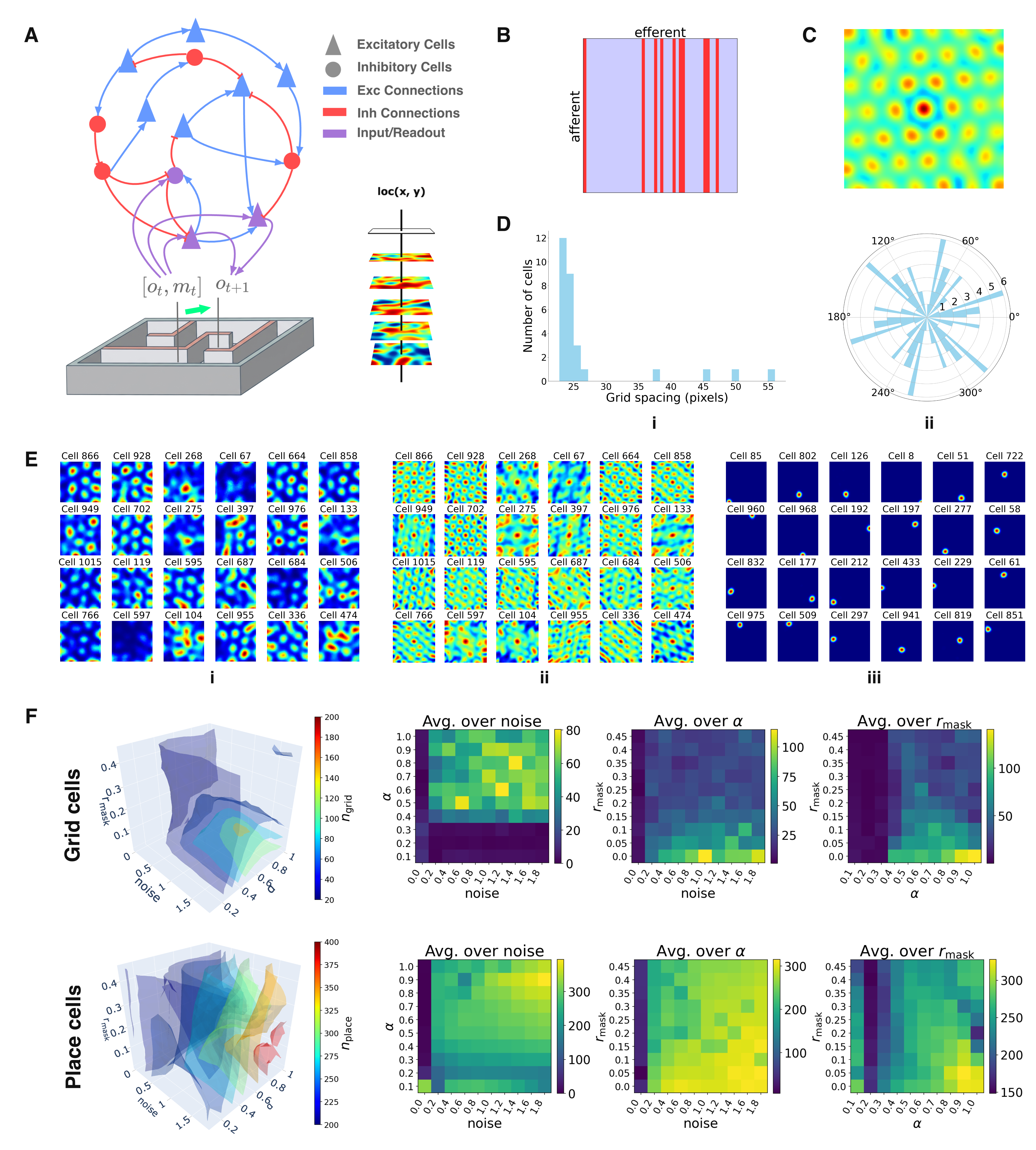
Recurrent network architecture, Dale-constrained connectivity, spatial autocorrelation, grid spacing and orientation, and examples of emergent grid and place fields
One predictive network, two complementary spatial codes.

How Can Two Spatial Codes Emerge Together?

Many models explain grid cells by assuming place cells already exist, or vice versa. We ask whether both can emerge together from predicting sensory experience during navigation.

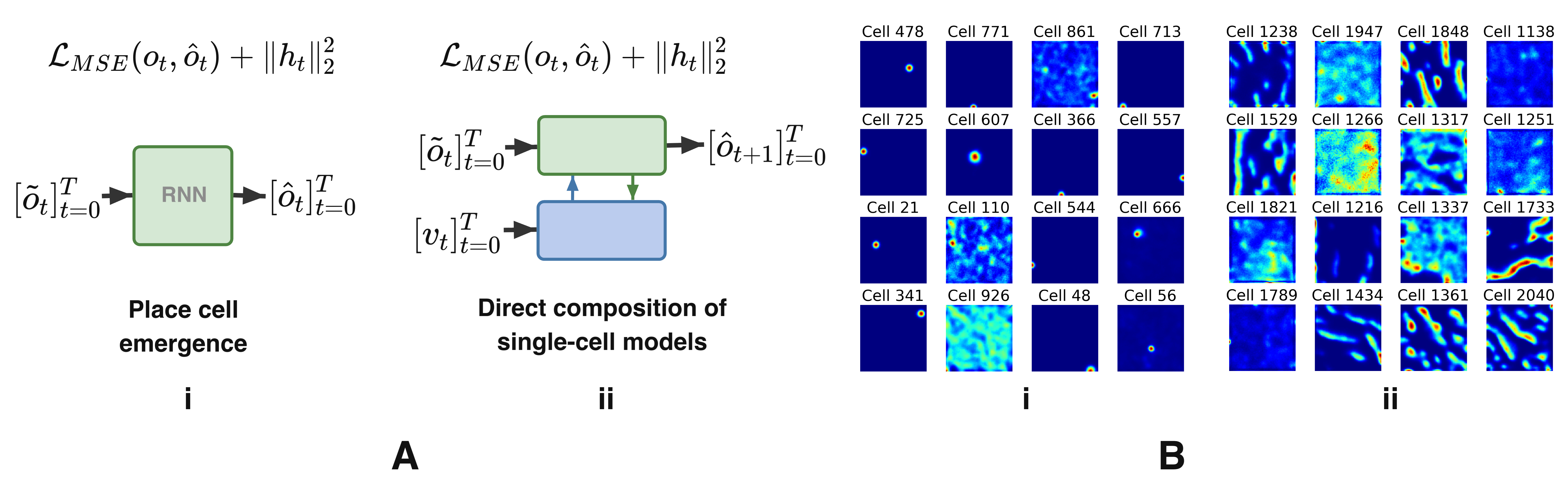
Single-cell-type models and their direct composition, with the resulting spatial response maps
Simply combining single-cell-type models does not yield robust co-emergence.

One Recurrent Network, One Predictive Objective

Of 2,048 recurrent units, half receive sensory and motion input; the rest receive only recurrent input. All learn through the same next-observation prediction objective.

Co-Emergent Grid and Place Fields

Repeated grid-like fields and localized place-like fields emerge in the same network, supporting complementary demands: recovering sensory state and updating it during movement.

Spatial Representations Across Environments


Developmental order, hairpin mazes, wall removal, connected rooms, and original three-dimensional place-like and grid-like firing fields
Spatial codes develop and reorganize across navigation conditions, including volumetric 3D traversal.

Code and Released Results

GitHub includes the model, simulator, training configurations, and saved rate maps. Explore the results in the notebook.

Cite this Paper

@misc{wang2026coemergence,
  title={A simple model of co-emergence of grid and place fields},
  author={Zhaoze Wang and Genela Morris and Dori Derdikman and Pratik Chaudhari and Vijay Balasubramanian},
  year={2026},
  eprint={2605.21356},
  archivePrefix={arXiv},
  primaryClass={q-bio.NC},
  url={https://arxiv.org/abs/2605.21356}
}